|
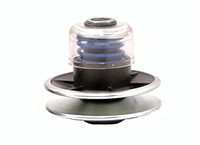
Variable Speed Pulley (VPS) Engineering Specifications ** Click on Desired Variable Speed Pulley for Detailed Technical Information* |
||||||
| Model | Belt | Speed Ratio |
HP Rating @ 1800 RPM |
Approx. Pitch Dia. |
Weight |
|
| VPS-15 | 3/8" V | Up to 2.45:1 | 1/4 | 1-3/8" Min 2-3/4" Max |
5 oz. | |
| VPS-20 | 1/2" V | Up to 2.8:1 | 1/2 | 1-7/16" Min 3-1/2" Max |
8 oz. | |
Scroll »
 |
|
||||||||||||||||||||||||||||||||||||||||||||||||||||||
|
Variable Speed Pulley (VPS) Spring Pressures ** Click on Desired Variable Speed Pulley for Detailed Technical Information* |
||||
| Model | Spring Strength | Color Code | LBS. COMPRESSION IN SPRING | |
|
As Pulley Starts
to Open |
Pulley
Fully Open |
|||
| VPS-15 | Medium Heavy |
White Blue |
14 17-1/2 |
18-1/2 22 |
| VPS-20 | Medium Heavy |
White Blue |
18 22 |
23 27-1/2 |
Variable Speed Pulleys are shipped with the blue, heavy strength spring unless another strength spring is requested.
Torque Transmission is an ISO Certified company.
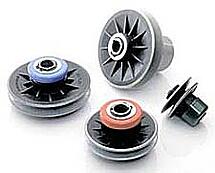
Speed range is infinitely variable within standard ratio limits. All of our variable speed pulleys are color-coded to indicate spring pressure - easy to identify and use.
Standard bores range from 3/8" to 5/8" in hex shaft design. These pulleys combine strength and cost savings of a steel hub and mounting shaft; the pulley flanges are a combination of glass-reinforced nylon and steel pulley face.
Designed for belt sizes from 3/8" V to 1/2" V and horsepower ratings up to 1/2 HP, including fractional horsepower ratings for smaller or more precise applications, they are engineered to offer an economical alternative for many applications that may not require the expense of AC/DC variable speed motors and drives.
Simple belt tensioning adjustments allow for speed changes from 2.45:1 up to 2.8:1. This speed change mechanism enables the rotational speed of the driven shaft to be increased or decreased as needed. The RPM (revolutions per minute) of the shaft can be decreased to match specific application requirements, providing flexibility for efficiency. The pulley system allows for precise adjustment of revolutions per minute (RPM) to optimize performance for various load conditions.
Speed adjustments can be made over time to accommodate changing load and application conditions, ensuring optimal performance and efficiency.
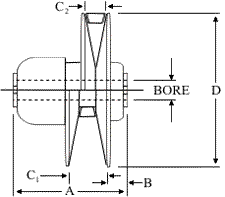
Standard variable speed pulley sizes and types, dimensions and spring pressures are listed below.
Standard Tolerances for Bore Sizes, Keyways and Setscrews
To learn more about the benefits and features of our variable speed pulleys, please explore the provided links or contact us for additional information.
Variable speed pulleys are designed for durability and consistent performance. They are used in applications that require precise speed control and long service life.
At the core of each pulley are movable flanges, typically made from:
Cast Iron Pulleys
Aluminum Pulleys
The material selection depends on application requirements—whether priority is strength and load capacity or weight reduction and thermal performance.
Each variable speed pulley mounts securely to the driven shaft and operates with the motor to provide a continuous range of speed adjustment within defined ratio limits.
Key system features include:
This adjustability is critical in applications where operating conditions change frequently.
The belt is a critical component of the system. It is designed to work with the pulley to deliver smooth speed transitions and controlled power transfer.
Benefits of proper belt and pulley design:
A full range of components is available to support system performance and customization:
Both standard and custom configurations are available. This allows for:
Torque Transmission provides guidance to help select the correct pulley system based on application needs. Support includes:
With decades of experience in variable speed drive systems, our team focuses on delivering reliable performance, extended service life, and efficient operation, contact us today.
Standard variable speed pulley sizes, types, dimensions, and spring pressures are listed below.


To Place an Order or Check Status of Order, Contact...
1246 High Street, Fairport Harbor, Ohio 44077 USA